Women
According to the Qur'an, Men and Women are equal before God; both created for the sole purpose of worshipping god through faith and good deeds
How does Islam elevate the status of women?
According to the Qur'an, men and women are equal before God; both created for the sole purpose of worshipping god through faith and good deeds. "O humankind! Be conscious of your Lord Who created you from a single soul, and out of it created its mate, and out of the two spread countless men and women. Be conscious of your Lord through Whom you demand your mutual rights and honor the wombs; God always watches over you." (Qur'an 4:1)
Islam recognizes women as individuals with specific rights. Among these are: the right to life, the right to learn; the right to earn, own and dispose property; the right to choose a husband; the right, as a wife, to her pre-marriage standard of living; the right to be treated equally; and the right to inherit. Women, like men, are rewarded by God for a righteously led life.
Muslim women dress in a way that is modest and dignified. The purpose of clothing is not only to protect oneself from physical elements, but also to protect oneself from immorality and pride.
Some traditions of dress, and more generally, the treatment of women in some Muslim countries and societies, are often a reflection of culture. These cultural influences, very often, are inconsistent with and even contrary to Islam teachings. Prophet Muhammad said: "The most perfect in faith among you believers is he who is best in manners and kindest to his wife."


What does the Qur’an say about Women’s Creation and Purpose?
From a tiny drop that becomes an embryo, the girl-child is born to be an honored part of God's plan. God states in the Muslim holy book, the Qur'an: "O humankind! Be conscious of your Lord Who created you from a single soul, and out of it created its mate, and out of the two spread countless men and women. Be conscious of your Lord through Whom you demand your mutual rights and honor the wombs; God always watches over you." (Qur'an 4:1)
According to the Qur'an, there are Gardens of Paradise. There was a forbidden tree, but no apple, no snake, and certainly no fault on Eve alone. Both Adam and Eve sinned at the same time. They felt shame for their deed, repented, and were forgiven together. God provided them with guidance, showing them a way back to Him.
"…Each soul earns on its own account: and no bearer of burden shall bear the burden of another..." (Qur'an 6:164) Therefore, the concept of the Original Sin does not exist in the tenets of Islam. Every child is considered born sinless and does not carry an inherited burden of sin.
"If any do deeds of righteousness, whether male or female, and have faith, they will enter Paradise and not the least injustice will be done to them." (Qur'an 4:124) The sole purpose and existence of both men and women is to worship God through faith and good deeds, fulfilling their role as God's honorable trustees and witnesses on this earth.
EBOOK
Does Islam give Women equal rights?
Yes, definitely. Islam teaches equality between women and men. However, in some Muslim countries and societies a patriarchal culture dominates, and women are denied of their God-given rights.
Nowhere does the Qur'an state that one gender is superior to another. God makes it clear that the only criterion for superiority is piety and righteousness…virtues only He can judge. "O humankind! We created you from a male and female, and made you into nations and tribes, so that you may come to know one another. Truly, the most honored of you in God's sight is the greatest of you in piety. God is All-Knowing, All-Aware." (Qur'an 49:13)
Islam recognizes women as individuals with specific rights. Among these are: the right to life, the right to learn; the right to earn, own and dispose property; the right to choose a husband; the right to a marriage gift; the right to retain her maiden name; the right as a wife, to her pre-marriage standard of living; the right to be treated equally; the right to seek divorce; the right to inherit; and the right to a final will.
Women, like men, are rewarded for a righteously led life. "…Whoever does good, whether male or female, and is a believer, will enter the Garden (of Paradise) where they will be provided with bounties beyond reckoning" (Qur'an 40:40)
EBOOK


What does Islam say about wives and husbands?
"And among His signs is that He created for you mates from among yourselves, that you may live in tranquility with them; and He has brought between you love and mercy. Truly, in this are signs for those who reflect." (Qur'an 30:21)
Marriage is based on mutual love and respect. The Islamic marriage is a sacred contract between a willing woman and willing man. There can be no coercion, and each party is free to include its own terms. The bride keeps her family name and her marriage gift from the groom. A Muslim marriage is completed with public festivities reflecting culture and customs.
Husbands and wives are protectors of each other. They are equal partners and best friends, remaining faithful to one another.
The husband provides, maintains, protects and is responsible for the family. He fulfills his duties with consultation and kindness. While the wife is not required to share her wealth and earnings, she may help her husband if she wishes. Both spouses work together in the home - cooking and cleaning - and in raising good children.
If couples are unable to live with one another peacefully, amicable divorce is permitted as a last resort. Mothers are given priority in the custody of children. Prophet Muhammad (may peace and blessings of God be upon him) said: "Treat women well and be kind to them; they are your partners and committed helpers."
EBOOK
What is written in the Qur’an about Motherhood?
"And We have enjoined upon man to be kind to his parents; in pain did his mother bear him, and in pain did she give him birth. The carrying of a child to his weaning is thirty months. At length, when he reaches the age of full strength and is forty years (old), he says, 'O my Lord! Grant me that I may be grateful for Your favors, that You bestowed me and upon both my parents; that I may do righteous deeds that are acceptable to You; and be gracious to me with regards to (my own) offspring. Surely, I turn to You repentant, and I wholly give myself (to You)." (Qur'an 46:15)
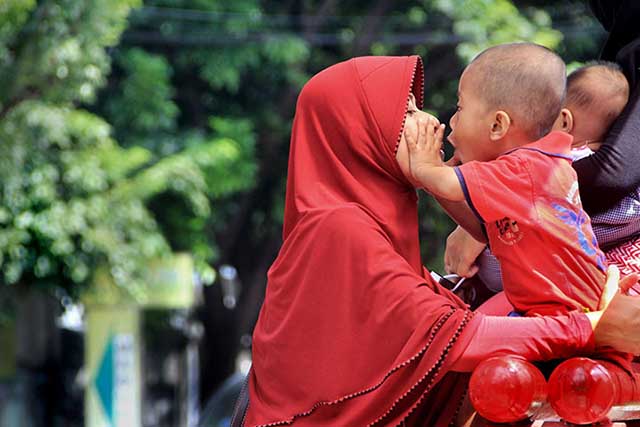
Mothers are accorded a special place of honor and respect in Islam.
A man once came to Prophet Muhammad and asked, "O Messenger of God! Who among the people is more worthy of my companionship?" The Prophet replied, "Your mother." Then man then asked who next, the Prophet replied "Your mother" again. The man repeated the question a third time and got the same answer. The man asked once again, "Who next?" Only then did the Prophet (peace and blessings of God be upon him) reply, "Your father."
These, and other references in the Qur'an and incidents from the life of the Prophet, clearly indicate the elevated status Islam has given to mothers. A Muslim sees a mother as an icon of strength and courage, tempered with compassion, kindness and love.
EBOOK

What do Muslims think about Mary, the Mother of Jesus?
Muslims deeply respect and admire Mary, the mother of Prophet Jesus (peace be upon them). She is the only woman honored with a chapter named after her in the Qur’an and is regarded as the highest example of virtue, strength, wisdom, and compassion.
Mary came from the family of Imran, descended from Aaron, and was raised under the care of Prophet Zechariah. The Qur’an speaks of her with exceptional honor: God chose and purified her above all women and gave her the glad tidings of Jesus, born miraculously by His command, “Be, and it is.”
The Qur’an describes her retreat, the pains of childbirth, and God’s miraculous comfort—providing a stream, dates, and guidance for her vow of silence. When she returned to her people with the infant Jesus, they questioned her, and the newborn spoke in her defense, declaring his prophethood, his devotion to God, his kindness to his mother, and peace upon him throughout his life, death, and resurrection.
EBOOK
Does Islam want women to be public and political?
Most certainly. Islam not only promotes, but charges women (and men) with the responsibility of using their minds for good, preventing evil as God's trustees on earth.
"The believing men and the believing women are protectors one of another; they enjoin good and forbid evil; they establish regular prayers; practice consistent charity; and they obey God and His Messenger. On them will God Pour His Mercy; for God is the Powerful, the Wise." (Qur'an 9:71)
Several Qur'anic verses chronicle female thinkers and doers, such as: Mary, the mother of Jesus; Bilquis, the Queen of Sheba who ruled justly and believed in the One God; and Aasiya, the Pharaoh's wife who saved Prophet Moses. History also tells of many great women: Aishah , the wise teacher and philosopher wife of Prophet Muhammad, who taught people daily for over 50 years; Fatimah, the daughter of the Prophet Muhammad for her virtuosity and immense patience; and Zubaydah, the famous builder of an aqueduct system for pilgrims.
In the first Islamic state in Madinah, Prophet Muhammad asked women to individually pledge loyalty (one person, one vote) to Islam and to his leadership. Women were expected then, as they are expected now, to assume their rightful role in society as committed partners.
Muslim women today work for the public good as activists, artists, entrepreneurs, leaders, scholars, scientists, social workers and teachers. Muslim women excel in all fields, not in spite of their religious convictions, but because of them.
EBOOK


Why do Muslim women dress the way they do?
"Say to the believing men that they should lower their gaze and guard their chastity; that will be purer for them. And God is well acquainted with all they do. And say to the believing women to lower their gaze and guard their chastity; that they should not display their beauty, except what (must ordinarily) appear thereof; that they should draw their coverings over their bosoms and not display their beauty except to their husbands, their fathers,…" (Qur'an 24:30-31)
God further states in the Qur'an: "Such elderly women as are past the prospect of marriage - there is no blame on them if they cast aside their (outer) garments, provided they do not make a wanton display of their beauty; but it is best for them to be modest; and God is the One Who sees and knows all things." (Qur'an 24:60)
Muslim women dress in a way that is modest and dignified. The purpose of clothing is not only to protect oneself from the physical elements, but also to protect from immorality and pride. The Islamic concept of dress applies to both women and men. It sets expectations of moral and respectful interactions between the genders. As a result, both men and women are liberated from their baser instincts and can focus on higher pursuits.
Islamic dress takes on many beautiful forms, reflecting the cultural diversity of Muslims from all over the world.
EBOOK
How does Islam protect women from violence?
Islam means "Peace" - achieved when a person focuses on God, giving her entire mind, heart and soul to none other than the Creator. This liberates her from human subjection; replacing fear with self-respect; weakness with strength, and conflict with tranquility. God says in the Qur'an: "…do not fear human beings, but be in awe of Me..." (Qur'an 5:44)
Islam strongly prohibits oppression or cruelty to any individual, group or living thing in the Universe. God enjoins good conduct toward women from birth to death. Verbal, psychological, emotional, sexual, and physical violence are forbidden, as are false allegations against women's chastity and honor. Men are further reminded: "...Do not annoy women as to make their lives miserable..." (Qur'an 65:6).
Prophet Muhammad said: "Only an honorable man treat women with honor and integrity. And only a mean, deceitful and dishonest man humiliates and insults women." Referring to physical abuse, he added: "Never hit your wives, they are your partners and sincere helpers." He exemplified this by never, ever, hitting a women or child. The Prophet guaranteed protection of the life, honor, and property of women.
"And why should you not fight in the cause of God and on behalf of those, who being weak, are ill-treated and oppressed, men, women and children whose cry is, 'Our Lord! Rescue us from these oppressors, and raise for us, from You, one who will protect and help.'" (Qur'an 4:75)
EBOOK


History

Islam

Jihad

Women

Family

Science

Interfaith

Prophets
Are you curious about Islam? Have you been looking for answers?
We have addressed many of the questions you may have about Islam.
Dig deeper. Watch a short video, download an eBook or chat with an expert.